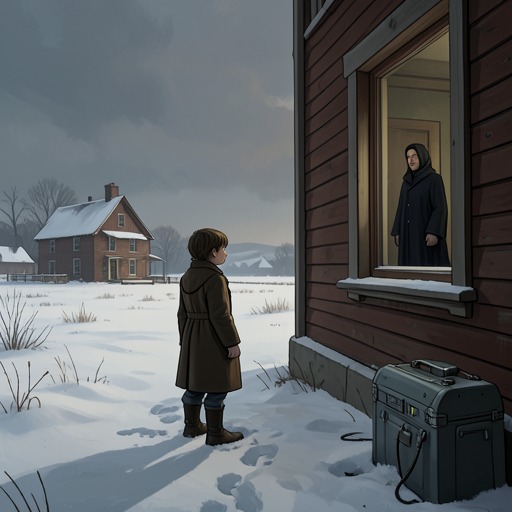
Nagornaia Station
Doctor ZhivagoNagornaia Station is the isolated signal post where Tania Bezocheredeva’s childhood story turns from separation and fear to escape. Three stations from the town, on a steep railway near the Chinese border, it is at once a household, a working railway outpost, and the scene from which a child enters the wider world alone.
Setting and railway life
In Tania’s recollection, Nagornaia Station lies beyond Krushitsy, in a remote region near the Chinese border. The route from the town passes Nizovaia before reaching Nagornaia, with Samsonov Pass beyond it. The station’s position is defined by the grade: trains coming from the direction of Russia descend so quickly that they need their brakes, while trains climbing the other way struggle up the hill. In autumn, when the woods thin, the station can be seen below as if set on a saucer.
The signal post includes a government-owned house beside the tracks and a substantial farm: a cow, a horse, poultry, and a large vegetable plot on land available without rent. The railway’s practical machinery is part of the place’s nightly life. A pusher engine is kept there to help freight trains up the hill, and a mixed train passes at roughly the same time each night. This regular traffic, first a familiar feature of Tania’s home, will later provide her only route to safety.
The household and Tania’s displacement
Tania says that when the Reds began advancing on the White-held town, her mother sent her to Nagornaia Station to stay with Marfa, a signal woman. Tania suspects that Marfa had known her mother from selling milk and vegetables in town. She cannot know whether her mother intended the separation to last: she thinks her mother may have been told that the arrangement was temporary, and insists that her mother would not knowingly have given her up forever. The account preserves that uncertainty rather than resolving it.
At the signal house, Tania calls the signal man, Vasilii, “Daddy.” She remembers him as kind, cheerful, and dangerously trusting, the sort of man who would tell a stranger everything about himself. Marfa, by contrast, never becomes “Mother” to her; Tania continues to call her “Aunt Marfa,” unable to forget her own mother and describing the woman who took her in as terrible. As a child, she remembers being coaxed toward Aunt Marfa with promises of gingerbread, then crying bitterly after her mother left. She recalls feeling so desperate that she wanted to hang herself. The station is therefore not simply a refuge from wartime displacement: it is also the place where that displacement becomes an intimate, lasting wound.
Violence at the signal house
Years later, during the New Economic Policy, inflation has made a thousand rubles scarcely worth a kopeck. Vasilii sells a cow and receives two sacks of money, which he boasts about around Nagornaia after drinking. On a stormy autumn day, a beggar woman arrives clutching her belly and begging to be taken to hospital. Vasilii harnesses Udaloy, the horse, puts her in the cart, and drives her eleven miles to the county hospital.
After Marfa and Tania have gone to bed, they hear the horse and cart return sooner than expected. Marfa opens the door and finds a threatening stranger instead of Vasilii. He says he has killed the old man in the woods and demands the proceeds from the cow. Tania’s account turns the station’s exposed, isolated position into immediate danger: help is distant, the household is under threat, and the money Vasilii publicized has brought violence to the door.
The railway as escape
Tania hears Udaloy neighing outside and imagines the horse urging her to flee for help. Then the familiar whistle of the station’s pusher engine sounds below. The engine seems to call her too, and Tania wonders whether fear has made her hear animals and machines speaking plain Russian. The hesitation is brief: the approaching train is too near for further thought.
She takes a lantern, runs to the track, and stands between the rails, waving its light. The train is moving slowly against the wind, and she manages to stop it. The driver knows her, but the wind prevents her from hearing his first words. She shouts that the signal house has been raided and that there has been murder and robbery. Red Army men jump from the army train onto the track and go to the house; they drag the killer from the cellar. They tie his hands and feet to the rails and drive the train over him, an act of immediate, brutal justice that ends the danger but does not restore Tania’s lost home.
Aftermath and narrative significance
Tania is too frightened to return for her clothes. She asks to be taken with the soldiers and leaves Nagornaia aboard the train. She says that she later wandered across much of Russia and other countries with homeless children, remembering that freedom after her childhood suffering came mixed with sin and misery. The station is thus the threshold between a confined and violent childhood and an uncertain life of movement; escape is real, but it is not a simple release from hardship.
Her story also depends on the station’s ordinary workings. The railway that once marked the boundary of her household becomes an instrument of rescue: the passing train, its known driver, the lantern, and the track itself make her flight possible. Tania’s recollection lingers on the farm, the steep grade, the nightly mixed train, and the familiar engine whistle, so that the place’s geography and routines are not background alone. They supply the means by which a child acts when the adults around her have failed her. After the story, Gordon and Dudorov walk silently beneath the trees; Gordon then asks whether Dudorov realizes who Tania is, leaving the recognition hanging at the end of the scene.